
Your Property Could Be Worth More Than You Think"
Here are the basics of how a property qualifies for a California Senate Bill 9 (SB 9) lot split.To qualify, a property must generally meet criteria in four main categories: Zoning, Lot Size, Owner Occupancy, and Property History.
1. Zoning & Location
Single-Family Zone: The property must be located within a single-family residential zone (typically R-1).
Urban Area: It must be within an urbanized area or urban cluster (as defined by the U.S. Census Bureau). Most populated areas in California qualify.
Not Historic: The property cannot be a designated historic landmark or located within a historic district.
Environmentally Safe: The site cannot be on prime farmland, wetlands, habitat for protected species, or usually high-risk fire/flood zones (unless specific mitigation measures are taken).
2. Lot Size & Dimensions
Minimum Size: The original lot must usually be at least 2,400 square feet.
The Split Ratio: The lot must be split roughly in half. The smaller of the two new lots cannot be smaller than 40% of the original lot's size (a 60/40 split is the maximum disparity).
Resulting Lot Size: Each of the two new lots must be at least 1,200 square feet.
3. Owner Occupancy
3-Year Requirement: The owner must sign an affidavit stating they intend to live in one of the units (on either of the two new lots) as their primary residence for at least three years from the date the lot split is approved.
Note: This rule prevents developers from buying homes, splitting them, and immediately selling both halves.
4. Property History & Tenants
No Recent Tenants: You generally cannot use SB 9 if the property currently has a tenant, or has had a tenant in the last 3 years.
No Rent Control: You cannot demolish or alter housing that is subject to rent control or price control.
No Ellis Act Evictions: You cannot use SB 9 if the property was subject to an Ellis Act eviction in the last 15 years.
No Prior SB 9 Splits: The lot cannot have been established by a previous SB 9 split (you can’t split a lot that was already split using this law).
No Adjacent Splits: The same owner (or a person acting in concert with the owner) cannot split adjacent lots.
Summary of What is Allowed
If the property qualifies, SB 9 allows you to:
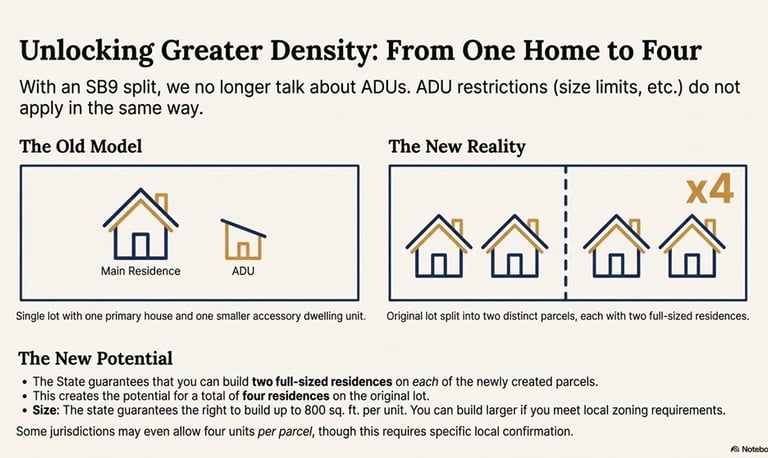
Split the lot into two separate parcels.
Build up to two units on each new parcel (for a total of 4 units across the original land area).
The say the proof is in the pudding so here you go.Sam Andreano is currently putting the finishing touches on his split-lot property in Whittier. He’s a guinea pig for state Senate Bill 9, a housing law that allows homeowners to divvy up their properties and build two or even four units on a once-single-family lot.
Andreano, 59, was one of SB 9’s earliest adopters. He bought a single-family home for $790,000 in 2021, split the property in half and sold the existing home on half of the original lot for $777,777 in 2023 — essentially coming out with an empty lot for a little over $12,000, around what it would have cost in the 1970s.
Then, Andreano spent around $400,000 building a home onto the back half of the original lot. He estimates it’ll be worth around $850,000 when it’s finished..
California SB 9 Lot Split
Send us a message and we will send you a link to see if your property qualifies